 Debrecen4U
January 23, 2026
Debrecen4U
January 23, 2026
Debrecen Culture Foundation Awards Ceremony – 2026
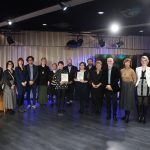
As per its tradition, the Debrecen Culture Foundation presented its awards—the Debrecen Culture Award and its creative scholarships—on January 22, Hungarian Culture Day, in the Munkácsy Hall of the Déri Museum.
The Debrecen Culture Foundation was established in 1991 with to assume patronage of the city’s intellectual and cultural life. It encourages and supports the artistic and cultural endeavors of private individuals, institutions, and ensembles, and assists in the development of cultural relations both in Hungary and abroad.
This year’s award recipients were welcomed by Dr. Mihály Duffek, professor emeritus of the Faculty of Music at the University of Debrecen and chairman of the board of trustees of the Debrecen Culture Foundation. Among other things, he noted that the Debrecen Culture Award recognizes a lifetime achievement, while the creative scholarship is directed toward the future.
The Debrecen Culture Award may be granted in recognition of outstanding work and a comprehensive life’s work that has created lasting value over many years in the fields of social and natural sciences as well as in cultural life. In 2026, the foundation awarded the Debrecen Culture Award to two individuals: music educator Lilla Nagyné Lövei, founder and director of the Hangbújócska Music Nursery, and Éva Nuridsány, painter and enamel artist.
Lilla Nagyné Lövei has been a defining figure in the cultural and educational life of Debrecen and its surrounding region for nearly 20 years. Her professional expertise is unquestionable: after completing her studies at the Zoltán Kodály Secondary School of Music and the Franz Liszt Academy of Music, she gained extensive experience as a music school teacher and through working with preschool-aged children. The unique methodology she developed, called “Hangbújócska,” is based on Hungarian nursery rhymes, folk songs, and lap games.
The sessions are not merely musical activities, but also represent a comprehensive artistic and community-building mission that brings the love of music, the treasures of Hungarian folk culture, and the joy of playing together to hundreds of families through the youngest age group. Her work is exemplary in nurturing the city’s future cultural generations, as—following the spirit of Zoltán Kodály—she integrates musical education into everyday life from the earliest stages, beginning already in infancy.
The art of Éva Nuridsány, who has roots in Miercurea Ciuc, represents a meeting of quiet contemplation and a deep intellectual heritage. Her painting is not merely a visual experience, but also serves as a kind of bridge between Transylvanian roots, family traditions, and modern Hungarian fine art.
The intellectual legacy brought from home and the respect for Transylvanian artistic tradition have become integral parts of her perspective, while also enabling her to create her own individual voice and unique technique, through which she has become a defining figure in contemporary Hungarian fine art. Throughout her career, she has demonstrated in numerous solo and group exhibitions how one can progress from traditional landscape painting toward pure, transcendent forms. Her works can be found in several public collections, preserving a spirit that seeks not only to see the world, but also to feel and understand it.
The Debrecen Culture Foundation announced a call for applications to support the activities of artists, art professionals, researchers, specialist writers, and cultural and heritage groups living in the city, with the aim of strengthening their ties to Debrecen. In 2026, the foundation is awarding creative scholarships to six individuals (János Komiszár, István Lente, Dr. Ádám Novák, Zsuzsa Szász, Judit Törökné Vajda, and Emese Lévai) and one association (Cívisporta Nonprofit Cultural Civil Association).
Painter János Komiszár intends to use the scholarship to publish two major works. One is his book on Kossuth Prize–winning painter László Holló, completed last autumn and containing 300 color images; the other is titled Fine Arts at Student Level, or Twenty Years of the National Secondary School Student Exhibition of Fine Arts. This spring, he also plans to organize an anniversary exhibition combined with a book launch, the realization of which will be significantly supported by the creative scholarship.
The practice of classical graphic art forms has a strong tradition in Debrecen, and even today many creative artists are engaged in it. At the same time, the use of digital image technology in autonomous works of art is less widespread. Graphic designer and visual artist István Lente aims to strengthen the recognition and appreciation of this modern branch of graphic art among Debrecen-based artists. He plans to use the scholarship to print, install, and exhibit his digitally created works, as well as to hold a four-part lecture series on digital graphics at the Downtown Creative Workshop.
This year marks the 500th anniversary of the Battle of Mohács, one of the greatest tragedies in Hungarian history. Historian Dr. Ádám Novák aims to create a visually engaging short scientific and educational film presenting original relics related to the Battle of Mohács that are preserved in Debrecen, including coins, manuscripts, and paintings. The short film is being produced in cooperation with public collections and the Institute of History of the University of Debrecen. Through narration, the film will present the history, significance, and impact of the battle.
Visual artist Zsuzsa Szász, who plays an active role in the city’s fine arts scene, works in several artistic fields in addition to painting. Since 2006, she has participated in exhibitions—both solo and group shows—at home and abroad. Alongside painting, she also enjoys creating objects and textile artworks. This year, she plans to realize several exhibitions where her textile installations will be displayed alongside her paintings.
Judit Törökné Vajda and Emese Lévai are both dance educators and choreographers who submitted their application jointly. The aim of their project is to realize the dance theatre production titled Vaszilisza. The core theme of the story is how to overcome life’s trials, surmount difficulties, and learn to accept and love oneself.
It highlights that even from seemingly hopeless situations there is a way out, and that with faith and patience, arising difficulties can be overcome. According to the creators’ hopes, the performance will help young audiences in accepting and loving themselves and others.
The Cívisporta Association has been engaged in researching the local history of the city of Debrecen for nearly a decade, organizing exhibitions, hosting conferences, and producing online cultural content. The aim of their current project is to create and continuously expand a registry of Debrecen street names, the city’s transportation database, and a repository of civic architecture on the civisporta.hu website, which has now also become part of the Cívis Value Repository.
The event featured Zoltán Tordai, one of Hungary’s most outstanding musicians.
Source and photo credit: debrecen.hu